Aligning pixels…
All Projects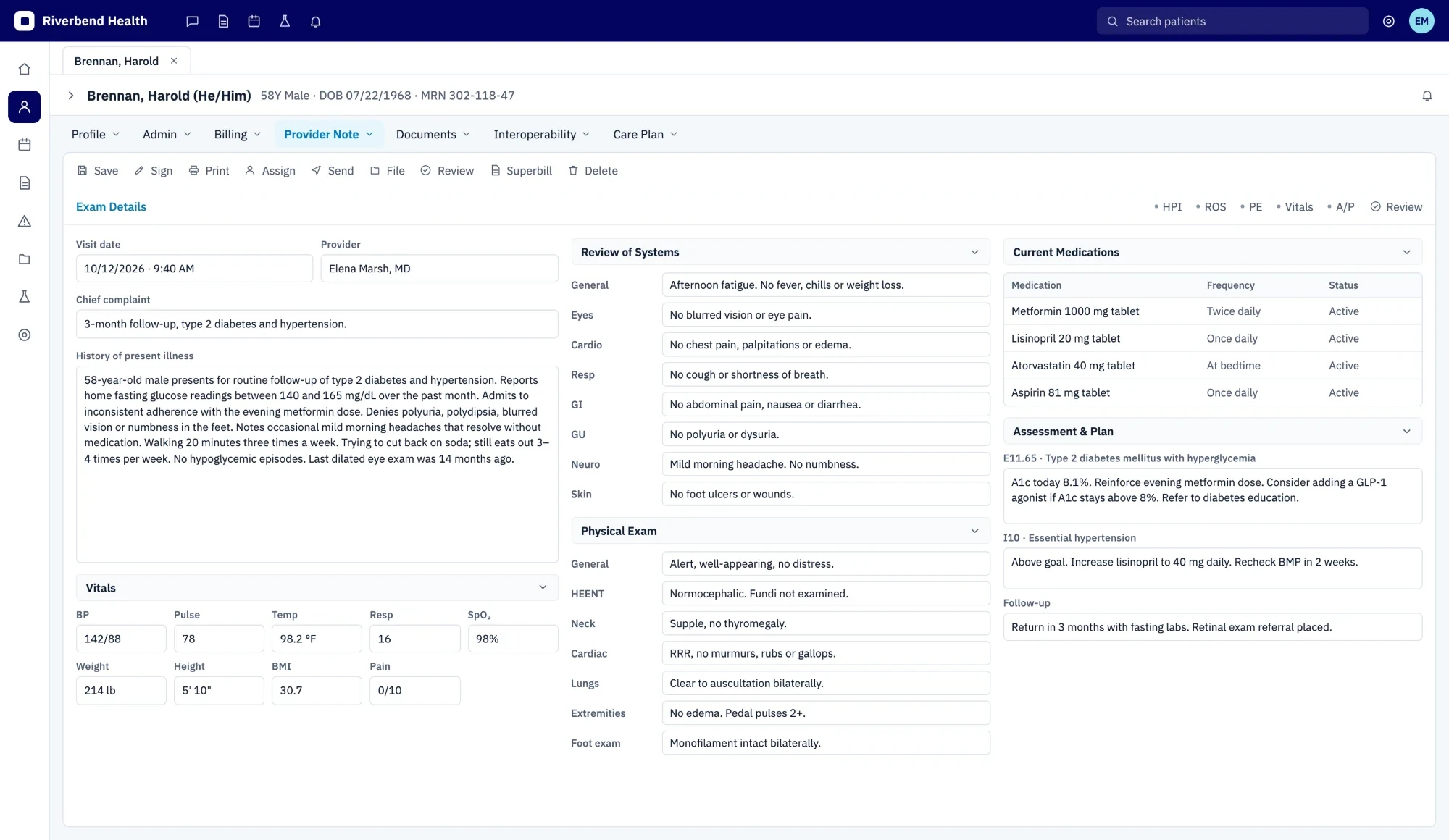
Enterprise · Healthcare · AI · UX Case Study
Scriva
Ambient Clinical Documentation Assistant
Role
Product Designer
Scope
End-to-end — initial ideation, competitor research, wireframing, design iteration, stakeholder reviews, and the final shipped solution
Team
Business Analyst, Product Owner, a clinical representative (a practicing physician), VP of Product, AI Engineers, Solution Architects
Domain
Healthcare EHR — Ambient Clinical Documentation / AI-Augmented Provider Workflow
Year
2026
98%
Accuracy across 50+ real test attempts
Flagship
High-priority 2026 initiative, shipped mid-year
Web + Mobile
Same experience across both
This case study describes real work and real design decisions. Screens shown are recreated, rebranded mockups — "Scriva" — not the actual product interface, to protect employer confidentiality. All names, patient data, and vendor details are fictional or generalized.
The Problem
Providers spend a significant part of every patient encounter — and a significant part of every day after it — documenting what happened, instead of focusing on the patient in front of them. The ask behind this project wasn't "add AI to the EHR." It was more specific and harder: reduce the actual time and cognitive load documentation takes, without asking providers to learn or trust a completely new way of working.
That second constraint mattered as much as the first. The primary users of this feature are providers, many between 45 and 60+ years old, already comfortable with their existing documentation habits. A powerful AI feature that requires learning a new interface, or that providers don't trust enough to rely on, doesn't reduce burden — it just adds a new one.
Before: a blank note, a manual typing task, and nothing else.
Research
The AI ambient scribe category was not empty water to step into — it's a fast-maturing, well-funded market. Established players include Microsoft's DAX Copilot (used by over 600 healthcare organizations, documenting over a million consultations a month), Abridge (over $300M raised, deployed across 200+ health systems), and others including Suki, Nabla, and DeepScribe, each already carving out specific strengths — voice-first interaction, EHR-agnostic flexibility, specialty-specific templates. This wasn't a race to be first; it was a need to build something genuinely well-suited to the existing provider base and clinical data, entering a category where the baseline expectations were already high.
The team studied around five direct competitors in depth — their recording flows, transcription approaches, note generation, clinical information extraction, and coding suggestions — through product demonstrations, released materials, and hands-on review. Indirect competitors (general voice-to-text and summarization tools) were reviewed too, to understand where structured, clinically-useful output was genuinely hard to get right versus where it was becoming commoditized.
One important strategic decision came out of this research: rather than licensing a third-party ambient scribe solution, the direction was to build the capability internally, so the feature could draw directly on the company's existing clinical and product data rather than treating documentation as a bolt-on feature.
Discarded Direction
The first concept explored wasn't an ambient scribe at all — it was an AI chatbot. The idea was that a conversational interface would feel natural: a provider could simply ask the AI questions and get answers, the way people were already getting used to interacting with AI elsewhere. Multiple chatbot concepts were explored and refined.
But working through the details surfaced the real flaw: a chatbot still required the provider to actively interact with a system — typing or talking to AI — instead of removing that interaction from their day. The team stepped back and asked more fundamental questions: what's the actual problem here, where are providers actually losing time, and how do we let them focus on the patient instead of the computer?
That reframing was the turning point. The goal was never "introduce an AI interface" — it was "remove documentation work from the provider's day entirely, wherever possible." That's what led to the ambient approach: instead of asking providers to talk to AI, let AI listen to the provider-patient conversation itself and turn that directly into a structured note.
The Key Insight
AI should reduce the provider's documentation workload — not become another task they have to learn, trust blindly, or manage. The provider needed to stay in control: reviewing, correcting, and approving what AI produced, never simply accepting it on faith.
The full experience became a single, clear chain: Listen → Transcribe → Extract → Structure → Generate → Review → Correct → Approve → Add to Note.
Design Decisions
01
Embedded inside the existing workflow, not a new app to learn
Scriva lives inside the Provider Note itself, accessed through an assistive panel, rather than as a standalone application. Providers can keep documenting manually if they prefer, or use Scriva when it helps — adoption wasn't forced, it was made easy to opt into.
02
A recording experience built around how clinical encounters actually happen
A persistent recording widget stays active even if the provider navigates to another part of the system mid-recording — a real clinical behavior (stepping away to examine a patient) shouldn't interrupt the capture.
If no voice is detected for 30 seconds, a "No voice detected" message appears for 10 seconds before the recording automatically pauses, preventing long stretches of silence from being captured unnecessarily. Up to three recordings can be attached to a single note (60 minutes each), covering situations like an initial conversation, a follow-up discussion, and anything captured later.
03
Surfacing uncertainty instead of hiding it inside a long note
Provider notes can run long, and an incorrect AI-generated detail buried somewhere inside one is a real risk. A color-coded system flags exactly this upfront: blue for information correctly matched by AI, yellow for information already present in the patient's existing record, and red for information that's uncertain or needs the provider's attention — collected into a single "Need Correction" area rather than left for the provider to hunt down.
Topics that genuinely weren't discussed during the encounter are explicitly labeled "Not Discussed," rather than left blank — a blank field looks like an AI mistake; a labeled one clearly isn't.
04
A deliberate boundary between what AI generated and what the provider added
Providers can correct or remove AI-detected information directly, but they cannot type entirely new clinical information straight into an AI-generated section. If something was missed, they can create another recording and let AI process it properly, or add it manually elsewhere in the note.
This wasn't a limitation for its own sake — it preserves a clear, traceable distinction between AI-generated and provider-entered information, which matters in a medical record where provenance of information can matter as much as the information itself.
05
Transparency built in, not bolted on afterward
A disclaimer sits on the main Scriva screen, plainly stating that the assistant helps with recording and transcription but isn't error-free, that patient consent must be obtained and documented before recording, and that professional judgment is required to verify accuracy.
Providers also always retain access to the original transcript, so if something seems off in the generated note, they can check what was actually said rather than simply discarding the AI's output outright.
Collaboration
This started with the Business Analyst bringing the initial problem and asking for exploration of different directions — from there, the team worked in frequent, often daily, review cycles with the Product Owner and a clinical representative (a practicing physician), presenting progress, working through open questions, and incorporating feedback continuously given the project's priority.
Later stages brought in the VP of Product, AI Engineers, and Solution Architects to align the design direction with what was technically feasible to build under a tight, high-priority timeline.
Outcomes
Internally, the most rigorously validated result is specific and defensible: testing with clinical staff across more than 50 real test attempts showed 98% accuracy in capturing spoken content and correctly mapping it into the right note sections. Broader claims about overall adoption and provider satisfaction were real but based on internal team impressions rather than a formal study, so this case study doesn't state them as measured fact.
For context on why this category of work matters at all: independent research on ambient clinical scribes has found meaningful, measurable impact elsewhere in the industry — a JAMA Network Open study of 263 clinicians found burnout dropped from 51.9% to 38.8% after 30 days of ambient scribe use, and a separate randomized trial of 238 physicians found roughly a 10% reduction in documentation time. Scriva was built into the same category these studies describe, with the specific, internally-tested accuracy result above as its own validated evidence.
Scriva shipped as a flagship initiative in mid-2026, available with the same experience on both web and mobile.
Reflection
The willingness to discard the chatbot concept — after real work had already gone into it — was the most important decision in this entire project, not a footnote to it. It's easy to ship the first idea that feels innovative; it's harder to ask "does this actually remove work, or just relocate it" and be willing to start over when the honest answer is the latter.
That same instinct — surface what needs a human's attention, stay quiet about what doesn't, and never let the system quietly overstate its own certainty — is the same thread running through the eligibility verification and appointments worklist redesigns before this one. Across three very different problems, it's become a consistent way of thinking about design, not a one-off decision.